This post may be too personal and totally inappropriate, but maybe it’s the perfect time…
Tip of the Day: Processing
7.
Tip of the Day: Processing
When it comes to processing information, there are two kinds of people who have a knack for falling into traps.
The first kind are those with a tendency to act impulsively. They hear or see something and have an immediate reaction. They may be wrong, they may not have understood it correctly, they may have even gotten a message that wasn’t intended for them… but hey – they got triggered, so “sorry ‘bout that, my bad… and whoopsie, please be more specific next time.”
The second kind likes to overthink everything and do the exact opposite of the first kind. But hey – at least they don’t act on impulse, right? (Hint: this is a rhetorical question, and yes, the answer is “wrong.”)
Then again, there’s also a special place in hell for people like me – who like to overthink things and then act impulsively – if you’re my kind: see you in hell, you little brain mush! 🫶
Anyway, back to the overthinkers. The skill of overthinking stems from many sources.
Sometimes, these are people who once acted impulsively and then got burned, so they realized it might be better for them to think in advance before they react in the future. Now, if the burn they got was that of a second degree, then the chances are that they skipped the action of standard processing and fell into the trap of overthinking, because inaction offers a false sense of security.
There is also a large number of people who overthink for this same reason, even though they never got burned. It’s just safer not to do anything. But the action of spinning different scenarios in your head still offers that sense of motion and potential accomplishment.
Some overthinkers mask overthinking as their passion – or obsession, take it as it resonates – with planning. They are so good at laying out the details that they’ve got Plan A, Plan B, a back-up plan, a contingency plan, and all other letters of the alphabet along with an endless streak of secret codes all stacked up and ready for action. However, when the time for action does come, the spark has either gone out, or it was never meant to shine in the first place.
Obviously, there are people who disguise overthinking as procrastination and just go back and forth without ever really going anywhere except spiraling down one level at a time.
Then again, there are people who overthink out of fear because they don’t have mechanisms for coping with either failure or success, so overthinking keeps them in that nice limbo of inaction that we mentioned earlier. These people usually focus on the most negative sides of what-ifs.
Because, let’s face it, not every overthinking is essentially negative. A lot of it is nicely wrapped into the deception of “how could I make this better / safer / improved / more accessible / more affordable / insert any comparative you deem appropriate.”
So, if you really want to escape the anguish of the overthinking loop, make sure you’re not only aware of when it happens, but also why it happens – be it fear, procrastination, planning, inaction, or whatever pushes your buttons in the wrong way.
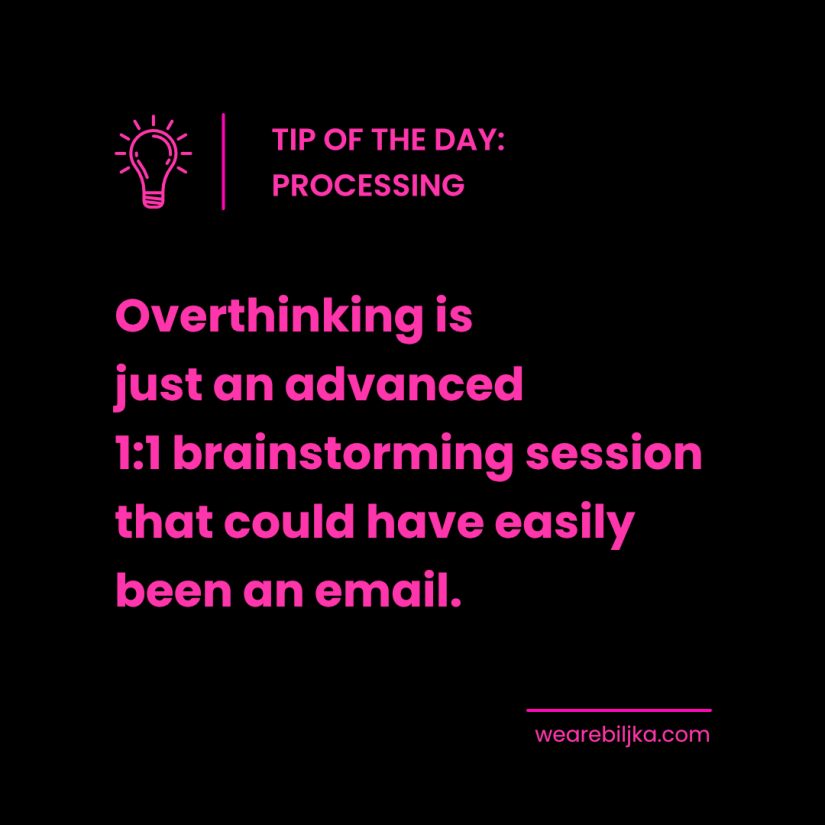
The benefit you gain is very simple: cutting overthinking increases your free time, productivity, and focus because, basically, overthinking is just an advanced 1:1 brainstorming session that could have easily been an email.

Related Posts
