Every earlier twist returns at once. Pronounce the tricky phrases, swap words, fix glitches and add your own ideas – all without losing the message.
Confidently Unstuck: Building the “Curveball Catchers Cohort”
So, I finally started that podcast… (Drumroll, please! A round of applause. Congrats to me, and all the other festive cheers.)
It’s called Herbal Tea Spillage, and I know this is long overdue, but at least I finally did it!
Much like all other things that were totally unplanned, so was the topic of the first episode.
Yet here we are. In the first episode, we’re spilling the tea on planning and we’re designing a mini-course together! (Check out the video below. If the video is not here yet – bear with me, please, it’ll be here asap!).
If you are an educator, a facilitator, or just someone who needs to fill a session, workshop, or course with meaningful activities and you need a quick recipe to do so – stick around – you may find this useful.
We are using a top-down approach, based on one of the exercises we do in PREXcoaching®, starting with the big-picture idea and moving toward the practical details. Here is exactly how I did it, and you can build along whatever you need pretty easily too.
I. The Blueprint & Identity
Theme
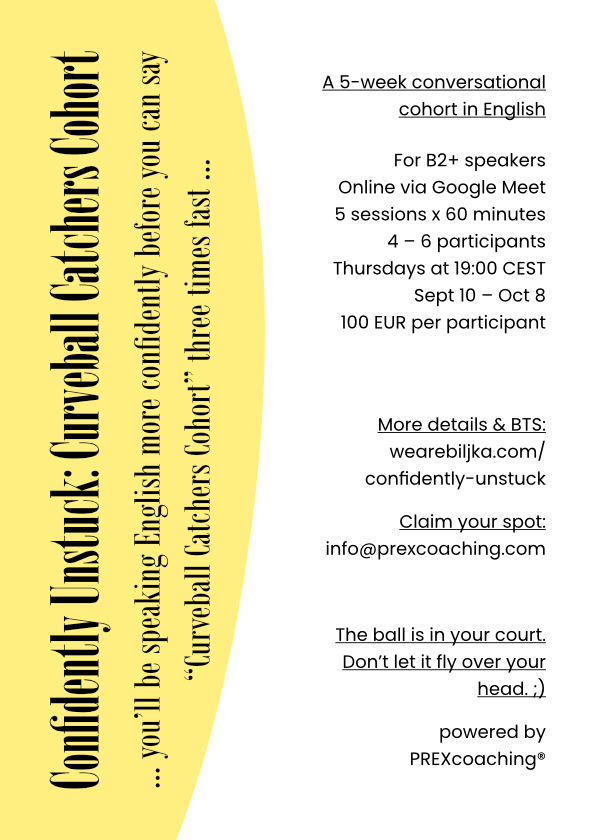
We’re designing a 5-week conversational English cohort.
Purpose
The purpose of this cohort is to help people become unstuck, speak more freely, and feel more confident handling real-life conversational curveballs in English.
Audience (↔ Topics)
Our target audience are adult learners and professionals at a B2/upper-intermediate to higher level of English. For this reason, we are going to rely on business and current topics.
Methodology
Because we want this to be entertaining, practical, and useful, we’re putting a massive focus on skills: presenting, pitching, storytelling, communicating, and negotiating.
Title & Branding
We want the title to reflect the purpose, so the main title is Confidently Unstuck. But since I absolutely love wordplay, puns, and idioms, we’re adding a baseball-themed subtitle: Curveball Catchers Cohort.
For the tagline, we’re using our ultimate promise to our participants: You’ll be speaking English more confidently before you can say “Curveball Catchers Cohort” three times fast.
Now do me a favor and try saying “Curveball Catchers Cohort” three times fast. See? We’re already having fun!
Side note on AI: If you get stuck brainstorming, consult ChatGPT or another LLM of your choice. However, be aware that the results you get are mostly copyrighted, trademarked, or already in general use, which is logical. Filter out what’s in use, generic, or what doesn’t resonate, and work with the rest. And, if you’re lucky, you may just win a jackpot and find a unique name!
II. Structure & Logistics
Format
This is a CBC (Cohort-Based Course), meaning we are focusing heavily on the shared experience of the participants, not just the learning process itself.
Duration
In total, we’re having 5 sessions at 60 minutes each.
Group Size
To make sure everyone gets enough time to speak, we’re limiting it to 4 – 6 participants.
Content/Outline
Here is what our mini-syllabus looks like:
Session 1: Networking
We’re playing networking and socializing games to create a strong bond right out of the gate, e.g. Speed Networking, Profile Bingo, Never Have I Ever, Find Someone Who, etc.
Session 2: Storytelling & Presenting
Here we’re describing an image, idea, or product, and relating the background story.
Session 3: Debates
We’re using “hot takes” as our topics, but here is the catch: participants are assigned their stance in advance. Clearly, we want to focus on critical thinking, not emotions!
This is also a perfect time to use a special motivation booster – a reward for the best debater or cohort participant in general, for example, a free 1:1 session.
Another side note on AI: If you ever get stuck brainstorming hot takes, use ChatGPT. Make sure you give a few prompts as examples to get the best results. If you’re not good at prompting, just ask it to make the best prompt for what you need, revise it and copy it back. Once you get the results, filter out what doesn’t resonate, and you’re good to go.
Session 4: Planning
We’re combining pitching and elaborating into a fun simulation exercise, like the one you’re following now.
Session 5: Wild Card
We are going to design this final session when the time comes, based entirely on the specific needs, experiences, and vibes of the cohort from the first four weeks.
III. Design Principles
Having a solid syllabus is great, but how you manage the room is what makes or breaks a course. Here are some of the things we have considered:
Time Management
We’ll be paying special attention to speaking distribution per person and per course.
For balancing the teacher vs. student speaking time, we’ll rely on the Pareto Principle. Meaning, yours truly will only be talking about 20% of the time, while the remaining 80% will be entirely at the participant’s disposal.
Customization
We’re going to customize the topics to always meet our cohort to the greatest extent possible.
Engagement Curves
For our sessions, we’ll be taking several engagement principles into account: the Attention Curve, Ebbinghaus’s Forgetting Curve, the primacy and recency effect, Johnstone and Percival’s work on attention breaks, Medina’s practical “10-minute rule,” and the zig-zag Interest Curve popularized by Jesse Schell in his book The Art of Game Design: A Book of Lenses.
Simply put, people tend to remember beginnings and endings more easily than the middle (the so-called primacy and recency effect). This is why we’ll be breaking each session into smaller, more manageable units.
Every 10 to 15 minutes, we’ll break the pattern with new activities. That doesn’t always mean starting a brand-new activity; it could just mean switching the focus from one person to another, asking a new question, adding a new rule, changing the interaction format, or moving from speaking to reflection.
We’ll also be using the zig-zag Interest Curve across the whole cohort, making sure the experience has movement. (Warm recommendation: Although Schell’s book is more referenced in the context of video games, it is nevertheless a wonderful read for anyone interested in creating interactive, playful, and engaging learning experiences.)
Style
We’re keeping things highly improvised with very little or no prep, relying on the PREXcoaching® principles.
Feedback
Even though this is a conversational English cohort, corrections are important to some participants, so we’re going to take real-time notes and include them in a stress test challenge either after each session or at the end of the cohort, depending on each particular cohort.
Ready to get unstuck?
If you are someone who could benefit from a conversational English cohort designed to boost your English-speaking skills, the wait is over.
The ball is in your court… don’t let it fly over your head!
Grab your template or claim your spot in the cohort!
In the meantime, check out the first episode, and I’ll see you in the next one!
